
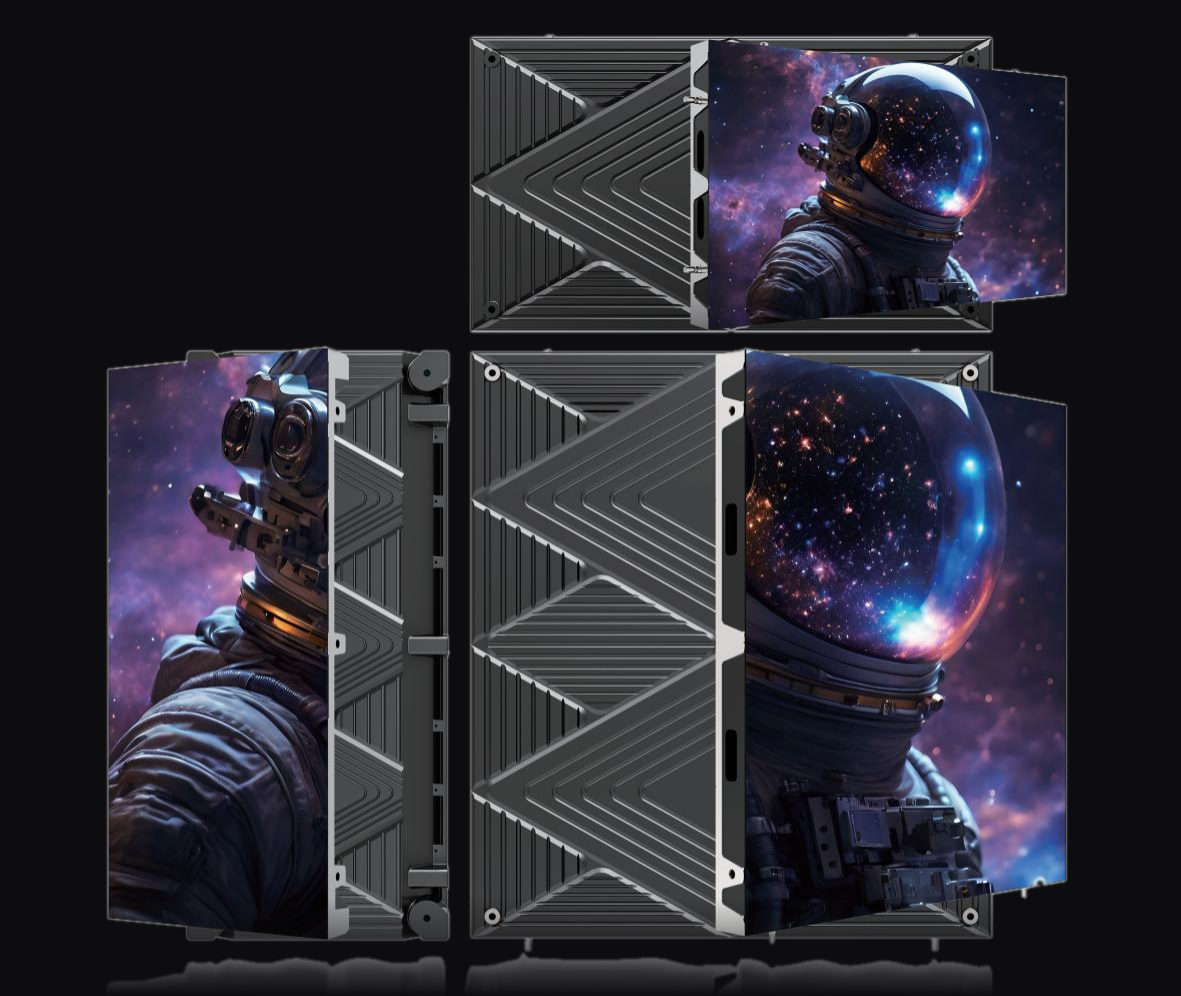
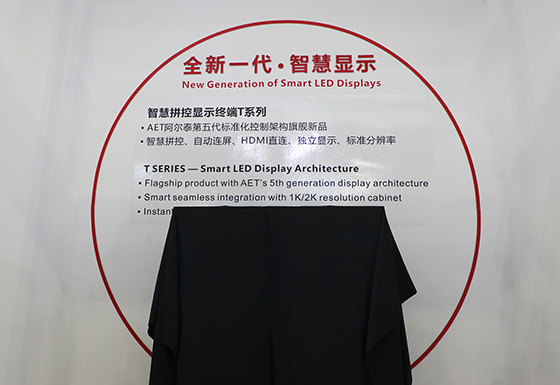
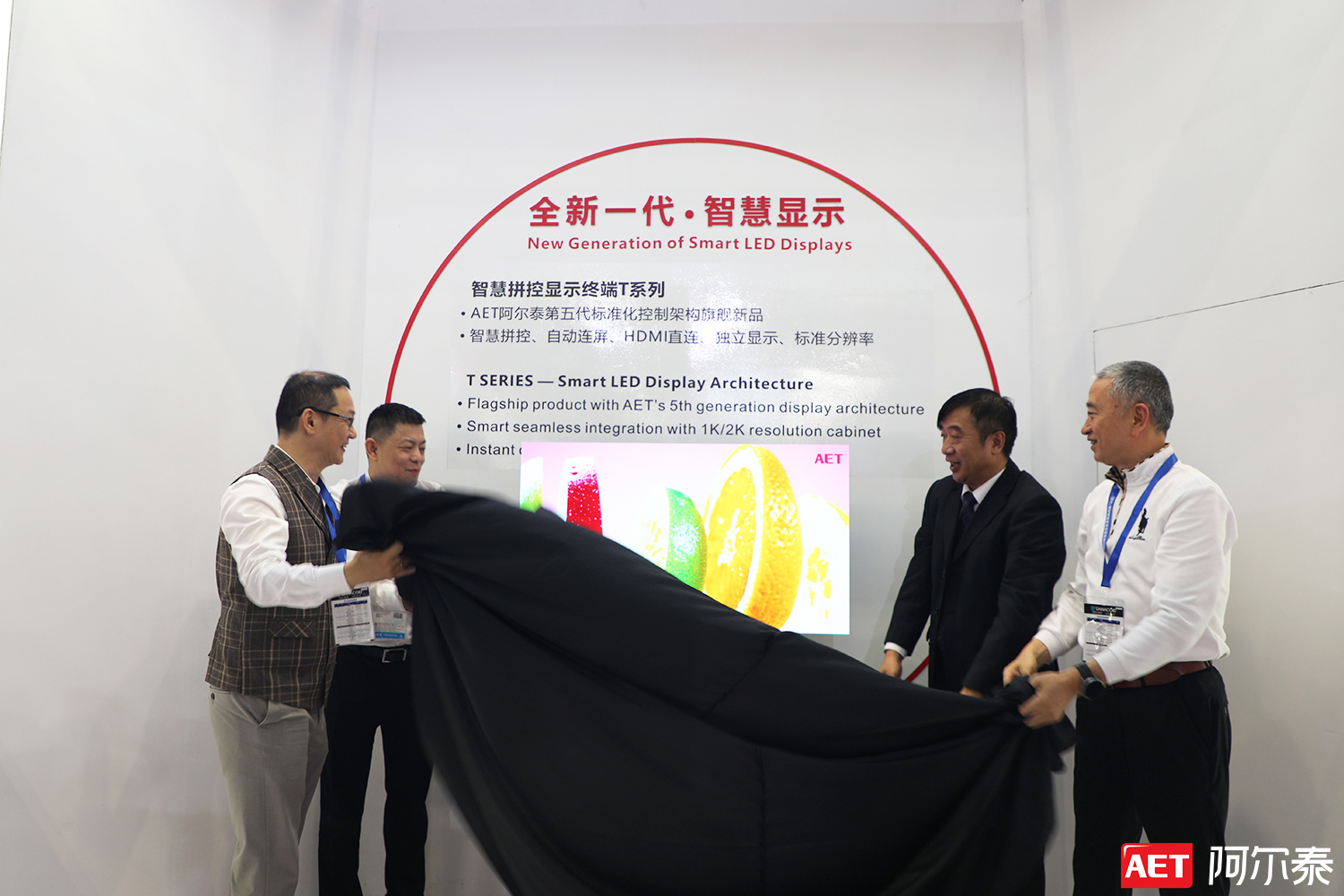
How far is LED display from being a consumer product? What breaks first in a standardised architecture? On 7 April at ISLE 2023, AET put a product behind the questions and introduced the T series smart control display terminal.
The T series runs AET’s fifth-generation standard architecture, which the company summarises as two layers, three channels, four components and five standards. It offers independent 1K and 2K display, low-brightness high-greyscale processing, 7,680 Hz refresh, 144 Hz frame support, HDR10+ compatibility, a 170-degree-plus viewing angle, 18-bit greyscale and a 28 mm body.
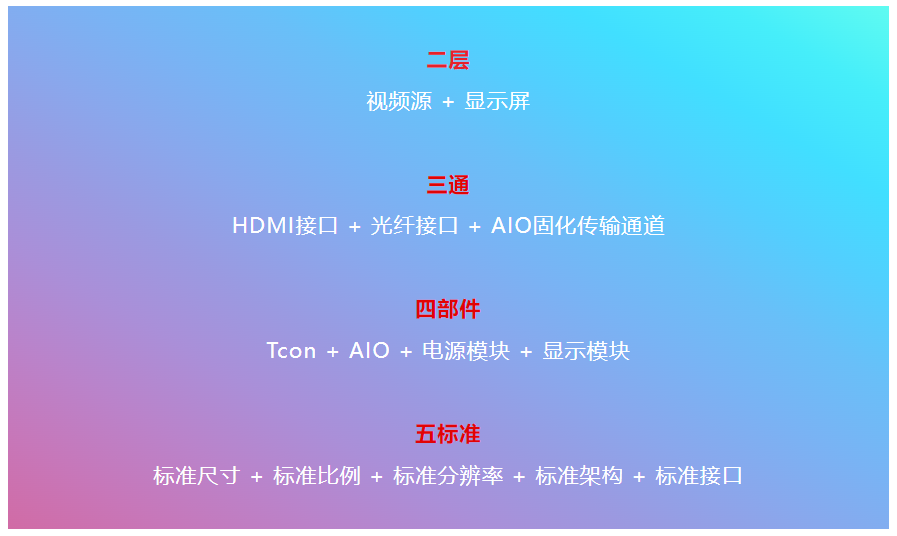
Two Layers: Remove the Boxes
The conventional chain is a computer, a video processor, a sending box and then the screen. The T series replaces it with a video source and a display, and nothing in between: no sending card, no on-site configuration, plug in and the screen is a screen.
Three Channels: One Cable
Connection is a universal HDMI port, an optical fibre port and the AIO fixed transmission path, running bottom to top. Assembled as a 4K display, the wall takes a single HDMI or fibre cable as input.
Four Components: One Bill of Materials
Internally the product is reduced to a TCON, an AIO board, a power module and a display module. Because the internal architecture is identical across sizes, the bill of materials is unified as well.
Five Standards: A Product, Not a Project
-
Standard size — 32, 43, 46, 55 and 60 inches
-
Standard ratio — 16:9
-
Standard resolution — independent 1K and 2K display
-
Standard architecture — the same internals at every size
-
Standard interface — HDMI, optical fibre and AIO
The series also carries electromagnetic compatibility to Class B, and supports CCC, CE, CB and BIS certification.
Why Standardisation, and Why It Is Hard
Direct-view LED has been in development for nearly forty years, from single-colour indoor panels to full-colour indoor and outdoor, and now to Mini and Micro LED. Throughout, it has been short of common standards.
The control architecture settled into a shape of its own: video source, standard video port, sending card, gigabit network cable, receiving card, adapter board, ribbon cable, driver IC, LED device. Every link is a separate purchase and a separate failure mode.
The hardware is more fragmented still. Modules and unit boards vary in outline, in the number and arrangement of the boards inside them, in power and data routing, in connector design, in size, in pixel count, in data allocation and in drive method.
The cost of that fragmentation is borne twice: once in design and inventory, and again in the field, where every new application restarts the customisation process. It is the main reason LED display stayed inside specialist and project work instead of reaching general use.
A Decade of Work Behind One Launch
AET began research on standardised architecture in 2014, proposed the TCON concept in 2019, built a standardised product in 2020, and brought the third-generation AT series to ISLE in May 2021. The T series is the fifth generation, and the first to be launched as a platform rather than as an incremental product.
“The point is not one technology upgrade,” the company said at the launch. “It is a systematic change in what an LED display is: a product with a fixed architecture, an identical parts list and a standard interface, rather than a screen assembled for one site.”
T Series
Contact AET for specifications, a sample unit, or a briefing on the standard architecture.
Related Articles & Insights
AET Opens Global Recruitment Across R&D, Sales and Service
AET has opened a global recruitment round covering display research, engineering, overseas sales and field service.
Five Extremes: How AET Plans to Grow
Minimalist architecture, frontier technology, visual quality, fine pitch and fast service: the five directions AET has organised i...